
Tuesday, December 13, 2016


Sunday, December 11, 2016
On the 13th Day of Xmas Groove gave us Gayla Peevey
Gayla Peevey - I want a hippopotamus for Christmas
On the 11th Day of Xmas Groove gave us Alice Francis' very noir little video 'Shoot Him Down'
Alice Francis - Shoot Him Down
On the 9th Day of Xmas Groove gave me The Speak Easy Three
The Speak Easy Three - When I get low, I get high
Thursday, December 08, 2016
Wednesday, December 07, 2016
The Groove Book Report : Gottfried Lindauer's New Zealand The Maori Portraits - Edited by Ngahiraka Mason and Zara Stanhope

This book coincides with a major exhibition currently on at the Auckland Art Gallery. This is an opportunity to explore Aotearoa New Zealand’s rich history through more than 120 historical portraits of Māori and Pākehā by our most prolific professional colonial painter, Gottfried Lindauer.
Through this incredible collection (some privately owned, some in public hands such as the War Memorial Museum and Te Papa) you can experience for yourself the power of Māori chiefs and leaders whose images are forever recorded in oil, and see how artist Gottfried Lindauer captured the practice of tā moko (facial tattoo). Gottfried's attention to detail was almost photographic. He was obsessed with the accuracy, capturing not just the idea but almost the very soul of the skin's owners. The exhibition also includes photographs, taonga (treasures) and keepsakes, allowing you to discover Lindauer’s early art beginnings in Europe, as well as his life in New Zealand from his arrival in Wellington in 1874 until his death in Woodville in 1926. And through out we learn about about the artist’s early days in Bohemia, his artistic inventions in New Zealand, and the close relationships he built with patrons and those he photographed and painted. Discover how the artist contributed to the significance of portraiture in New Zealand and learn what his works mean for us today.
The first 50 pages concentrate on Lindauer's background and his biography. Emeritus Professor Patu Hohepa offers us a short introduction and prayer in Te Reo, a kind of blessing that anoints the reader and makes this journey extra special. Auckland Art Gallery Director Rhana Devenport provides, in a potted perspective in the introduction, of an incredible life. From the 1870s to the early twentieth century, the Bohemian immigrant artist Gottfried Lindauer travelled to marae and rural towns around New Zealand and – commissioned by Māori and Pākehā – captured in paint the images of key Māori figures. For Māori then and now, the faces of tūpuna are full of mana and life. Now this definitive book on Lindauer’s portraits of the ancestors collects that work for New Zealanders.
What is so fantastic about this book is the wonderful quality of the reproduction of the 67 major portraits and 8 genre paintings, accompanied by well researched and detailed accounts of each subject. I was on a Marae last month and was reminded that the photos displayed in the hare nui represent the ancestors - in fact while they are in the house, they are alive and part of the proceedings. Just imagine the absolute joy for Ngati Raukawa when they come face to face with a portrait of Karawira Kapu (1883), the niece of Hitiri e Parekawa. Kapu, herself was a major land holder in South Waikato and Taupo, she made claims to land in the Native Land Court, and had tried to influence the government land purchasers of the day. Plus, in Western society, she was a woman. Women of note were still far and few so the fact that Lindauer knew she was important and chose to paint her portrait speaks volumes about his own egalitarianism and tolerance for his sitters who came to his Queen Street studio in Auckland, where Māori visited to see their ancestors; and the afterlife of the paintings in marae and memory. For Māori, the faces that look out from Lindauer’s portraits are tribal leaders and family members. They are tohunga and politicians. They are ancestors and friends. Gottfried Lindauer met Maori tūpuna at the most basic level of human connection by capturing their likeness. This book returns the ancestors and the artist to the people.
At the end of the book there are a number of essays on the painter and his subjects. Auckland Art Gallery Conservator Ute Larson and Auckland University Art Historian Jane Davidson-Ladd take us on a fascinating and intimate journey through Lindauer's personal relationship with painting and photography. I was particularly taken with the accompanying painted photographs of Beatrix and Gertrude Anthony which still pop with energy. They have the same mystique and grace as the best handcrafted photographs but with the depth of a painting and the clinical accuracy of a photo.
Sarah Hillary (Principal Conservator Auckland Art Gallery) takes us deep into Lindauer's Paint box to find out about his techniques and inventions. Being so far from Europe he was free to paint as he wanted, without the inhibitions or the restraints of the salons of Paris or elsewhere. His approaches were not only innovative at time but also refreshing - even to the antipodeans that made up his patrons. With the aid of a special ultraviolet light we can see the cross sections from the cloak in his painting Tamati Waka Te Puhi, which shows multiple layers and the resinous glaze between the grey and black paints that has levels of protein to maintain the luster even a hundred years later. This is but one of the miracles revealed but there are plenty more.
Chanel Clarke (Maori Curator at Auckland Art Gallery) takes a look at the costuming in Lindauer's painting and asks why some of the subjects choose to wear Western clothing but others remain in the traditional or remain on the Pa as opposed to in the studio. What also strikes me is how Lindauer never stoops to exploit his subjects or make them into cheap postcard images, which were so popular at the time. He chooses to allow them to extol their mana through his oils. Of course, it's no secret that his paintings also reveal the crumbling of the old world, as Western society takes hold. This is the most evident in portraits like King Tawhiao ad his wife Hera who are photographed between 1880 and 1894 in a mix of top hats, jackets and cloaks. An almost comical Victorian cartoon of the 'natives' - had it not been for the fact that these people in their Sunday best really dressed like this and it was as normal to them as seeing a Kaumatua wearing a tracksuit and sneakers today.
Ngarino Ellis looks at personal adornment and how Lindauer captured the details and the spirit of moko, jewelry and hei tiki. An important thing to note was that these paintings reserve these pieces in a way keeping them and their special significance alive. A Hei Tiki, for instance, could have special mana for the wearer, so it was essential that this was preserved in the painting.
Kahutoi Te Kanawa and Ngahirataka Mason look at the Kakahu tradition, that of weaving. Lindauer again was obsessed by the details and fascinated by the new crafts of Maori. In the painting Heenai Hirini and Child (1878), for instance, he captures the cloak's white flax, red dots and black string strands with a very special touch. It's so delicately done, you can almost touch the fabric. This essay interweaves photos and comments about how the garment was made and how it was weaved, to give context and reference.
Finally, Jane Davidson-Ladd looks at the 'Speaking Likeness', as she notes that Lindauer's Pakeha portreaits have all but been overlooked in the modern age, compared t the Maori subjects. Ad it is unknown how many there actually are in existence. A contemporary Joseph Kofensky estimated that it was around 1000. Art historian Leonard Bell estimates that about 2/3 of his subjects over his career were pakeha. Davidson-Ladd looks at his appeal and why he was in so much demand, perhaps because of his photographic eye. His most awesome skill. "As viewers," she proffers, "we have the agency to make them (the portraits) once again a speaking likeness".
http://www.press.auckland.ac.nz/en/browse-books/all-books/books-2016/gottfried-lindauer-s-new-zealand.html

On the 7th Day of Christmas Groove Gave to me - Michael Bublé: It's Beginning To Look A Lot Like Christmas
Wednesday, November 16, 2016
Groove Book Report - New Zealand Wine: The Land, the Vines, the People - Warren Moran (Auckland University Press)

For half a century, geographer and wine enthusiast Warren Moran has followed the development of the industry, talked to the winemakers and tasted the wines. In this book, he provides an unrivalled introduction to New Zealand wine: the climate, soils, and geography our winemakers work with; the grape varieties they have tried to tame; and the extraordinary personalities, families and companies who have made the wine and the industry. After introducing readers to the history and geography of New Zealand wine, this monumental book takes readers to each of the key winegrowing regions to tell the story of wines and winemakers in Auckland, Gisborne, Hawke’s Bay, the Wairarapa, Marlborough, Canterbury and Central Otago.
Illustrated with three-dimensional maps of regions and localities and spectacular photographs of the vineyards, the wines, and the winemakers, New Zealand Wine: The Land, the Vines, the People is a must for all of those interested in understanding the extraordinary wines of New Zealand.
Boy, this is such a book. Way more than just another book about winemakers or vintages. With topographical maps, detailed histories and personal accounts, this is more like a three dimensional journey into each region. The stories behind how we end u planting in Central Otago, just beyond Queenstown - places like Chard Farm - are extraordinary. Some of the stories involve the science of viticulture and some tell of the decisions made through good noses and intuition. Many of the earliest wine makers were from the Balkan regions, the Yugos and the Germans, who, like the Delegat family saw potential in the soil. And some were actually almost banished to the northern regions of Auckland, like Kumeu, to try to grow grapes among the apples and stone fruit. The story of Gimlet Gravels is another story of mixing science and intuition.
Moran has worked with a number of wonderful map makers to show just how detailed the soil and climate is under each region and just what makes it special for each. I'm sure, when you visit a winery they talk up the various local features and what contributes to their particular vintage. That's what this book does best. It gives you that insight down to the macrobiotic level.. A book for wine geeks and wine lovers for sure.
Warren Moran is a geographer and professor emeritus at the University of Auckland. Beginning with his 1958 MA thesis, Moran has published extensively on wine (and rural industries more generally) in New Zealand and overseas. He was co-author of an OUP book Geography: A Study of its Elements. Among other awards, he has been named a distinguished geographer by the New Zealand Geographical Society.
http://www.press.auckland.ac.nz/en/browse-books/all-books/books-2016/new-zealand-wine--the-land--the-vines--the-people-by-warren-mora.html
Groove Book Report - Rick Stein's Long Weekends

Still, shows like his BBC series Venice to Istanbul are both informative and deliciously adventurous. His new book certainly sums up the new series well with plenty of notes before each recipe on how he discovered each dish or how the locals should have it - in TV world, of course.
The easy ones are things like Spagetti Alla Bolognese, which is a mix of tomatoes, tuna flakes and Parmesan cheese. Definitely not the SPAG BOG conncoctions we make here at home. Even so, I always thought the famous dish was meat, carrots, celery, onions and tomatoes. Who knew there were other versions?
There are other different dishes, too. Some include local ingredients that you can get in the UK but not here, like Sardines. But others you can approximate like Icelandic BreadedLamb Chops and spiced red cabbage. The cabbage includes blueberries, the only really point of difference.
Some ingredients like cod and sea bass can be swapped with warehou or even terakahi and we can throw in good quality frozen prawns of even fresh clams. We can't get proper Serrano Ham - for Flamenco Eggs with Tomato and Serrano Ham - but we have some pretty good approximations these days.
This book covers entre's, mains and deserts from a 'day of the week' point of view. Friday's are quick, Saturday's a bit longer and Sunday's slow, time for the family, etc. It's also broken up into a chapter for each location, so you can cook something French one weekend, something Scandinavian the next and so on.
Finally, the back section is also a brilliant wee collection of 'Extras' : a good chicken stock, vege and beef stocks, a trick with saute potatoes, Beurre Mane, Sourdough Starter and a whole lot more.
The photos alone will make you yearn to update your passport and book one of those European river cruises or a cooking tour. They are great and match the dialogue brilliantly.
A brilliant book, if slightly a fantasy for most of us. At least we can cook for our dreams.
Monday, November 14, 2016
7.5 magnitude earthquake/power cut in NZ takes Groove off-air this morning.
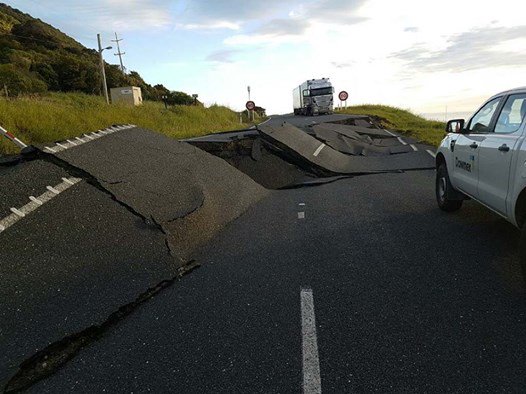 |
| Damaged road, South Island - NZ Transport Agency |
There has been damage to buildings in Wellington and the South Island and 2 people are known to have died as a result of the earthquake and aftershocks around the country. Currently there is damage to Ferry wharfs in Wellington and Picton so at this stage no Ferry's or trains are running but luckily there are barely any reports of people being injured.
The moon is the closest it has been to the Earth in about 60 years over the next couple of days...will there be quakes in other parts of the world? It pays to be prepared with spare water and food, torches, battery radio's etc.
Subscribe to:
Posts (Atom)


