Saturday, September 17, 2022
Tahi Festival: Gag Reflex - A Scanderlous Solo Show (Bats Theatre 16 & 17 September )
Wednesday, September 14, 2022
Tahi Festival - Agent Provocateurs by Jo Marsh (Bats Theatre 14 & 15 September)
Tahi Festival, at Bats Theatre
and Circa Theatre is a celebration of solo artists, a 10 day Festival dedicated
to showcasing the finest and most engaging solo performance from around the
motu.
Tonight we were treated to a
bit of historical cabaret with a twist. Australian born, now Wellington
based burlesque performer Jo Marsh aka Jo Jo Bellini can be seen on red light
stages around town but tonight she was a secret agent in waiting.
She told us that, like some of
her idols in this show, she too had wanted, from an early age to be a
spy. She wanted the romance, the sex, the adventure. She wasn't too
keen on the executions part though.
Her show mixes wit and wisdom,
song a salacious, saucy snippets of history as she profiles 5 amazing female
spies and one transgender provocateur.
Cheeky and full of attitude she
struts about her simple stage of archive boxes and manila folders whipping out
facts on the lives of WWI agent Mata Hari (did you know she was a wife and
mother as well as an exotic dancer?), Yoshiko Kawashima (who defied the onset
of Mao's Cultural Revolution in the Sino Japanese War), Ace Spy Nancy Wake
(better known as the White Mouse, and a Kiwi to boot), Mary Bowser (who's
photographic memory helped the Union to win the American Civil War), the
outrageous Madamoiselle Chavallier D'Eon de Beaumont (who was really a man, but
became a woman) and the WW2 spy Noor Inyat Khan (a woman of colour who spied
for the English, right under the noses of the Gestapo).
Marsh liberally flaunts her
favourite playlist ditties - Kim Carnes' Betty Davis Eyes, Blondie's One
Way Or Another, a bond theme - Nobody Does It Better - and more, rearranging
the lyrics to suit her characters, of whom she inhibits during each number.
My favourite scene was when Jo
is talking about Nancy Wake (who was a Wellingtonian - did you know that?) and
she reaches into her file box and pulls out a cat puppet with a swastika
armband and a mouse puppet who will sneak off with the cheese (a metaphor for stealing
war secrets) all performed while doing her best Debbie Harry
impression.
There are other magic moments
along the way, too. Her brash impression of Kawashima 'kicking against
the pricks' as a punk rebel hero was also memorable.
If anything Marsh was a little bit
let down by her own small falters. A line missed here, a spill
there. But nothing major.
Director and former flatmate Sameena Zehra keeps the action simple and effective, relies on the usual flourishes of cabaret, costume play and dance moves but also acknowledges Marsh's own personality and body movement. She doesn't get her to do anything that looks too posed or unnatural. This is Jo Marsh onstage, after all. I loved the show, the concept and the very idea of bringing history to life, especially HERSTORY like this is a very worthy thing. Can't wait to see what comes next from Jo Marsh et al!
Read more about Jo Marsh at Blog On The Tracks
Book and see Agent Provocateurs
Book a Tahi show here: https://www.tahifestivalnz.com/
Thursday, September 08, 2022
Others Way is back!
That's right, The Others Way Festival is back!
Save the date! Saturday October 22, when thirty of some of the finest live acts we know are set to play multiple local venues across Karangahape Road!
The full line-up will be unveiled in the weeks to come, but you know you there's going to be a batch of local gems, legends, luminaries and next-big-things! We think you'll be pretty dang happy!
Plus it's all happening on the Saturday of a long weekend, so you've got two whole days to recover. Let's party like it's 2020, 2021, and 2022!
Friday, August 26, 2022
WOMAD is Back: 20 Year anniversary - announcing the line up on 20 October
WOMAD 2023 will be announcing their line up on 20 October - Official Programme launch, plus we've got some teaser Music Announcements, STEAM, World of Words, Book Club, and so much more!
Get ready to celebrate #20years with us at WOMAD NZ 2023
As part of the World of Words programme, the WOMAD Poetry Slam 2023 showcases performance poets, putting them in the spotlight on the World of Words Stage, Kunming Garden.
A much-loved part of the festival programme, the Poetry Slam competition is all about poetry as a performance, a celebration of beats, verse, quips and rhythms that take poems from the page to the stage.
To celebrate National Poetry Day, organisers are opening up Poetry Slam Applications for 2023 with a message from the delightful Penny Ashton to all WOMAD’s wordsmiths.
The Slam Schedule
Saturday, March 18 - 4 pm, Kunming Garden
The contestants, festival-goers, will deliver their original spoken words in the hope of being crowned the WOMAD Slam Champ. WOMAD audience response plays an essential role in the judges’ scoring - so get along and cheer on this poetic fiesta.
Sunday, March 19 - 4 pm, Kunming Garden
The WOMAD Slam Champ will perform their winning piece, followed by a slam session from our world-renowned judges and seasoned slammers.
Prepare to be surprised, entertained and provoked by their lyrical genius moments, passionate prose and rhythmic rhymes.
The 2023 Poetry Slam Champ will take home a double VIP WOMAD 3-DAY PASS for 2024!
Wednesday, August 24, 2022
Kiwi singer Margaret Urlich, 57, dies after living with cancer for over two years
“She had a level of sophistication that marked her out,” he said. “Marg was super stylish, she oozed confidence but underneath, she was a female who had to overcome her shyness to try to make it in a male-dominated industry. And she did.” - Peter Urlich
Aria award-winning singer Margaret Urlich and one of Aotearoa's most successful musicians, has died aged 57.
Born in Auckland, Urlich died on Monday of cancer at her home in New South Wales’ Southern Highlands.
Urlich’s condition was known to her friends and colleagues, but kept private from the public ey at her whanau's request.
She came to our attention in 1985, fronting the new wave outfit Peking Man, before gaining even more fame as a member of the all-female pop group When The Cat’s Away.
'Melting Pot' went to No 1 on the New Zealand charts and sealed their fame as a go to live act. They were was inducted into the New Zealand Music Hall of Fame in December 2021.
“Margaret was a true and rare talent,” Dianne Swann (When The Cat’s Away) told Stuff.co.nz. “She lit up any room, and if you were on stage with her you had to lift your game. She was a uniquely gifted person, and I will always miss her.”
Urlich moved to Australia in 1988, to pursue her solo career. Her debut solo 'Escaping' made her the first female solo artist to top the NZ charts, and her debut 'Safety in Numbers' netted her an Aria award in 1991 - Best breakthrough artist.
That same year, her vocals were featured on Daryl Braithwaite’s megahit 'The Horses' (12 weeks in the Australian top 10).
Monday, May 30, 2022
Anthony Tonnon wins the 2022 Taite Music Prize
Whanganui-based singer-songwriter Anthonie Tonnon won the 2022 Taite Music Prize last night, for his critically-acclaimed third album Leave 'Love Out of This', picking up a $12,500 cash prize into the bargain
The annual award, which honours outstanding music releases from the previous calendar year, was a live event again, presented at Auckland’s Q Theatre last night. Tonnon, fresh off a nationwide tour, won over nine other finalists, including Luke Buda and Reb Fountain.
In his acceptance speech he thanked his wife Karlya Smith, his parents and “people and places that this album belongs to”. He said he wasn't expecting to win because the “quality of the other contenders’ was so strong.
“The album is the pinnacle of what I’ve aimed for as a musician. It’s the novel to us musicians,” he said.
He's spoken about the album previously, saying that it was about being part of the first generation growing up in the economic experiment New Zealand launched into during the 1980s. "This is a constant theme for me," he told RNZ, "it's been what I've banged on about through all my albums."
More than 300 artists, media and industry members packed out the Auckland theatre for the ceremony, hosted by NZ On Air’s Sarah Thompson.
The ceremony was opened by 2021 winner Reb Fountain performing 'Sampson' and 'Don’t You Know Who I Am' from her last album, self-titled.
The award, named after the late journalist Dylan Taite, honours outstanding Kiwi albums. Judging is based on artistic merit, rather than chart success or popularity. Previous winners include Lorde, Reb Fountain and Ladi6.
Sir Dave Dobbyn was also there, to present the Independent Spirit Award, which went to broadcasting veteran Karyn Hay, honoured for her trailblazing work on the 80s TV series 'Radio With Pictures', her career with Kiwi FM, documentary work and current host of RNZ National’s 'Lately' show. Hay says that this work is "just a part of who I am. Being proud of something you have championed isn’t how I see the world. I just do it, and hope the end result will hit home.”
There was also a special commendation made by Rolling Stone editor-in-chief, Poppy Reid, to Alison Mau for her important investigative work with Stuff, focussing on New Zealand music industry practices and the link with sexual harm and prevention. She said Mau’s work “is an outstanding contribution to the industry. John Tait, Dylan's son said "Her important investigative work for Stuff shone a light on unacceptable behaviour that has been ignored by the music industry for too long. Ali’s powerful journalism gave a voice to the victims and started a national dialogue that's driving systematic change.”
There was also the inaugural Outstanding Music Journalism Award, which was presented to RNZ Tony Stamp, who took away $2500 cash to spend on his record collection.
The Auckland Live Best Independent Debut went to Jazmine Mary for their debut album 'The Licking of a Tangerine'. The Independent Music NZ Classic Record award went to producer Alan Jansson for the 1994 Urban-Pacific street soul compilation, 'PROUD'.
Taite Music Prize 2022 winner Anthonie Tonnon's speech
Sunday, May 08, 2022
Review - 'Stranded Pieces' by Roaming Bodies (Bats Theatre 7 May 2022)
See Video on Vimeo
“Stripping back to Artist Matt Pine's connection to land/environment in his work grounds the work in uncovering possible connections.
Finding what were before, the 'Stranded Pieces'.
In this multidisciplinary work, dance, music and theatre forge new contexts to relate to the work of Matt Pine. Inspired by Matt Pine's ‘Placement Projects’ that took place at Auckland's City Arts Gallery in 1978 and revisited in 2016-2017 at Te Papa.
I most recently saw Caspar Ilschner in collaboration with fellow dancer Otto Kosok, musician Martin Greshoff, Designer Hollie Cohen, and Co-Producers Monique Gilmour and Isaac Kirkwood at Te Auaha as part of February’s NZ Fringe Festival 2022. Their show, The Professio(nah), was a vibrant and absurdist take on the old adage ‘stop mucking about and get a job!’
Under Red Light settings, it was a bizarre, isolationist
experience to attend, but as a dance piece, still highly creative and entertaining.
Tonight’s piece, ‘Stranded Pieces’ is a different beast. Performed in the sumptious dome room upstairs in Bats, it felt like a more 'polished' art piece.
It appears like the solo work of Ilschner but is definitely a collaboration, this time under the moniker 'Roaming
Bodies'. Most are recent Toi Whakaari graduates. It is a thought provoking contemporary
piece, in search of the missing connections between the multitudes of self
within community and environment.
In our current world, with the recent politics of vaccinations
and masks, isolation, society divisions, working from home, social distancing,
it is necessary to find the time and space to process our options as a
community. Where are we going. How do we
‘normalize’ the ‘new normal’? and where
does theatre sit in this? Dance and theatre is the mirror we hold up and we
look at the fragmented light, searching for meaning and clarity. How can this work in our modern society?
As a performance, each ‘piece’ is presented, like laying
down a piece of a puzzle, to be shuffled and reshuffled. They are bridged together through Ilschner’s
own body moves in a combination of distorted shapes, expressions challenging
and drawing you in. There with sound,
spoken word and live music build the picture.
Like Pine’s work, there are circles and, angles, segments and sections.
Roaming Bodies Stranded Pieces’s set and costume design are
inspired by Matt Pine's ‘Placement Projects’ that took place at Auckland's City
Arts Gallery in 1978 and a new installation at Te Papa in 2016-2017. The company, Roaming Bodies, takes the
ingredients for tonight’s incredible pot pouri of choreography, lighting and
music from Pine’s work.
To begin, and dressed completely in a white (of purity?) Ilschner
opens, playing what appears to be a modified trumpet, the sound lingering, haunting. It’s like an old fashioned Roman regalia, announcing
the start of something spectacular. But
then the lights dim and Hollie Cohen’s intricate, abstract Audio Visuals come
on to create the first scene (Cohen also did the projections for The
Professio(nah)).
The visuals feature organic cells (or digital elements like a
motherboard) mutating, expediential replication of themselves, like a virus –
is this a reference to Covid, of the spreading of Fake News?
Ilschner rotates his body in a prone position, he appears to
grow like a cell, multiplying into a greater life. Is this an artificial or organic body we are
witnessing?
With a sense of deliberate action, the bizarre and organic world
reveals its self, as if its growing like an amoeba. This man, creature, organic or digital body starts
to create his environment then goes about ordering it, arranging, labelling and
taming it like a garden from weeds to beauty.
There is a direct reference to the minimalist work of Pine,
like the architecture of Mies Van De Rohe, creating order in the simplicity. Clear away the clutter, the noise of multiple
‘fake’ voices, the media noise of our Covid times, the anxiety of our times,
breaking down the mayhem, the inevitable destruction.
Ilschner changes to a white plastic suit with black stripes. He tentatively puts it on, as if it’s an
alien cloak of some sort. Immediately I
thought of our own reactions to having to put on PPE or masks. There is a brief moment of hilarity as he
clumsily tries to put his arms in to the sleeve holes, a strange mash up of music
plays – a mix of tape loops, Tiny Tim and Ferris wheel music. A candy coating to hide a more sinister, or
clinical purpose for the clothing?
His dancing becomes violent, frantic punching as if he’s
attacking, or is he defending. The
lights become intensely blue. Are we
underwater? Are we hurtling through
space? Is the blue calming? Or is it a
symbol of sorrow?
Perhaps this was a storm, a tempest climaxing. This white suited about, like an explorer. His
arms seem to form a radar, and aerial, a searching device. Either way, he appears lost, bewildered.
Is this where we are now?
Our place, in this world, is a place of uncertainty?
Ilschner’s performance is mesmerising. It’s so much more delicate than the clowning,
clumsy expressions he chose for the ‘The Professio(nah)’. The paper that was so prominent on the set of
that show is here , too. If a little bit
less prevalent as it lines the back wall like an Otago plains landscape.
But this is a different work, for sure. He goes well beyond the simple vocabulary learned
from his years at Toi Whakaari, and the natural flow that comes over is easy to
interpret, even for someone like myself who is not familiar with the intricate world
of dance. That makes this show both even
more enjoyable and accessible. His method
of plying each phrase, disrupted by a spring-like lurches or twitch breaks up
the journey of movement, as if our very lives has been disrupted – and indeed
they have. Occasionally we get a surprise,
with a moment or two of humour, shattering the serious mood.
Sound artist Jackie Jenkins has been inspired, it seems by
the sounds of water, organic matter, digital machinations. The soundscape is a wash of blips and bops,
scritching, samples from songs and EDM, also seemingly random, like a DJ
scratching and mixing live, but in fact carefully curated to match the action
on stage.
As needed for dance, particularly in this long, narrow
space, is a minimal set, the ‘set’ mainly constituted by visuals and a few small
black boxes, the ‘stranded pieces’, which become tangible and occasionally malleable
props.
When Ilschner finally speaks, he gives voice to our own interpretations of the actions so far. It’s a revelation that won’t fit neatly into a box. These are the boxes that he’s just so neatly lined up in the previous segment. Small black paper boxes. One for emotions. Another for friends, another for foes – way over there. Things we understand, defined and categorised, suddenly smashed under foot. And there are more, that will all be mixed and mashed. Order will become chaos. A swirling mess. A metaphor for every day assaults on our mental health from distorted information, twisted realities, climate change and other impacts on our reality.
You can see Pine's ideas coming through, especially in the way
Colour is important, helped by the dramatic, textual visual
affects of Grace Newtown, Max de Roy intern and the addition of Kaitlyn
Johnston’s graphic design.
Once again thanks to Roaming Bodies for inviting me to review.
They are a company of Wellington based artists:
Caspar Ilschner: Performer and Choreographer
Jackie Jenkins: Sound Design
Grace Newton: Lighting and Set Design
Max de Roy: Costume Design and Assisting Intern for Set and
Lighting Design
Hollie Cohen: Projection Design
Kaitlyn Johnston Graphic Design
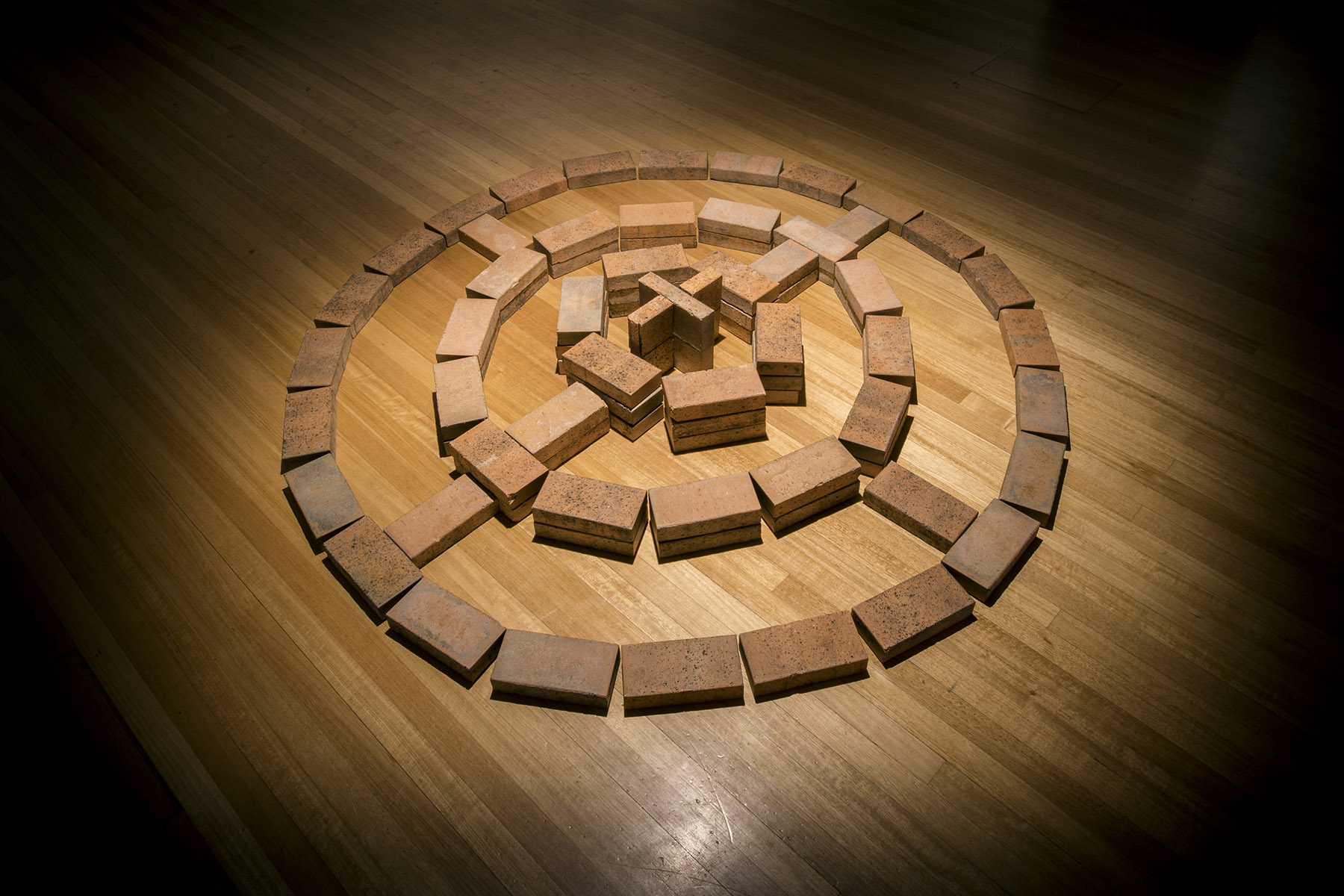
![]() |
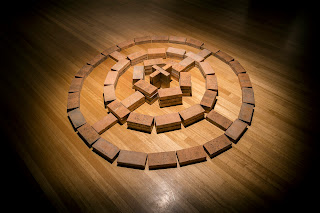
| Brick Work |
Matt Pine (1941–2021)
Matt Pine was born in Whanganui, attending Whanganui
Collegiate School, and later, graduating from the University of Canterbury
School of Fine Art (now known as Ilam School of Fine Arts) in 1959. He went on to also attend Elam School of Fine
Arts, graduating in 1962.
Following graduation he gained a scholarship to Hornsey
College of Art and the Central School of Arts & Crafts between 1962 and
1964. During hi time there Pine was
involved with the installation of minimalist works by artists such as Sol Le
Witt, Carl Andre, Donald Judd and Dan Flavin at the Tate Gallery. That had a huge influence on his own practice. He took inspiration from the constructivist
and minimalist movements.
He travelled through Asia, Russia, Africa and Europe before
returning to Aotearoa in 1974. He worked
on site specific mahi, while observing the formal aspects of Māori architecture
and ancestral sites. In 1979 he met Ralph Hotere during a Frances Hodgkins
Fellowship artist in residence in Dunedin. Both artists were operating at the intersection
between Te Ao Maori and minimalism.
Pine later became an art teacher and tutor around Whanganui
region from 1976 to 1999, establishing Te Wa / The Space (which moved to Palmerston
North in 2011).
Pine’s art reflects his experience of international artistic
movements, alongside Te Ao Māori. He made an important contribution to contemporary
Māori art and the wider art of Aotearoa’.
CoffeeBar Kid
Friday, May 06, 2022
We say farewell to Rural tv broadcaster John Gordon
![]() |
| Photo: Stuff |
Broadcaster John Gordon, famous in many households for his work on television programmes like 'Country Calendar' and 'A Dog’s Show', died at his home in Otautau last week, at the age of 78.
He worked on 95 editions of Country Calendar from 1976 to 1984 as as writer-director and occasionally in front of the camera. But he became famous on small screens when he presented and commentated the sheep dog trials show 'A Dog's Show' for 17 years - 1977-94.
After leaving the show he became a freelance journalist contracting to television and radio, alongside other commercial companies. During 1982-83 he directed five documentaries for TV, under the name of 'The Southlanders', featuring the province’s people, places, and events - 'Peg's Place (Taylor's Hotel, Ohai)', 'The Wyndham Anglers (Wyndham, Mataura and Mimihau Rivers)', 'The Forgotten Coast (Progress Valley-Waipapa Point and people who live there)', 'Married to the Place (views of Southland through an artist's eyes)' and 'The Settlers (new settlement in the Te Anau basin)'.
He also wrote a number of books including 'People Places And Paddocks', 'Mountains of the South', 'Three Sheep and a Dog, Out of Town', 'What's Its Name (dog names)', 'Fresh Fields' and 'Going There (about Gordon's time in Vietnam)'.
Gordon was a keen member of the Thornbury Vintage Tractor Club and their project – 'Southern Lands, the history of farming in Southland', which he supported up to his death.
Gordon also led two refugee welfare teams for the New Zealand Red Cross in South Vietnam, utilising his skills as an agriculturalist to people grow vegetables.
He worked for Volunteer Service Abroad through the early 1990s, as a farm manager and teacher in agriculture at a secondary school in Bougainville Island, Papua New Guineas. Later he took a commission for VSA in Cambodia and developed a radio programme for Cambodian farmers.
John Gordon was a passionate Southlander, broadcaster and humanitarian and we will all miss him here at Groove. Our lives were enriched by his Television, especially the way he brought rural New Zealand into our homes every Sunday night. It expanded our young minds and made us all the better for it.
![]() |
| Photo: Stuff |
See more clips from John Gordon at NZ on Screen
See more episodes of 'A Dog's Show'
Other classic Kiwi TV moments
Tuesday, April 12, 2022
Troy Kingi wins the 2021 APRA Silver Scrolls
Maisey Rika (Te Whānau-a-Apanui) and Seth Haapu (Ngāti Porou, Ngāti Tūwharetoa, Te Atihaunui a Pāpārangi) were recieved the Maioha Award for 'Waitī Waitā' from Rika's album Ngā Mata o te Ariki Tāwhirimatea. The waiata spotlights Waitī and Waitā, two stars that form part of the Matariki cluster, expressing their connection with each other and tangata whenua.
Friday, March 11, 2022
REVIEW: Aotearoa NZ Festival Of The Arts: Adam Chamber Music Series - Concert 1: Voice of the Whale (Online until April 3 2022)
Performers: Helene Pohl (Violin), Rolf Gjelsten (Cello), Nicola Melville (Piano), Bridget Douglas - Flute
The Chamber Music Series is a set of five separate concerts that artfully balance the familiar and the out of the ordinary. The brief was to bring together works that were rarely heard works with the more familiar, such as the beloved Bach Chaconne, and to juxtapose them with other masterworks to enhance the emotional impact of each programme.
The series covers quintets for string quartet, taonga pūoro with a Romantic piano quintet, a performance of Mozart’s epic Gran Partita and the Enescu Octet in Chamber
Music spectacular, world music celebrating nature and emotion (‘Voice of the Whale’) and solace in a troubled world with Bach by Candlelight. Sadly, in these Covid times we cannot attend in person. But if we did, then we’d all be crowded into the Michael Fowler Centre, wine in hand and buzzing with anticipation. Alas, only the musicians were ably to step inside. As a compromise, though
‘Tonight’s’ concert was a digitally streamed event featuring the groundbreaking 'Vox Balaenae (Voice of the Whale' by Pulitzer Prize and Grammy award winner George Crumb, Brazilian composer Heitor 'Villa-Lobos’ Assobio a Játo (Jet Whistle)' , Bacewicz’s Violin Sonata No. 4 and Rachmaninoff’s 'Trio elegiaque No.1 in G minor'.
George Crumb: ‘Vox Balaenae (Voice of the Whale)’
George Henry Crumb Jr. was an American composer of contemporary classical music, who early in his life chose to reject the modernist usage of serialism, popular at the time, instead developing a highly personal musical language which ranged from peaceful to downright nightmarish.
What Crumb has written gives a distinct musical voice to the cause, whilst providing a richly vivid seascape and endearing empathy with these magnificent creatures. At the heart of the piece is the contemporary relationship between humans and whale. It’s something of a chronological journey touching on science, especially studies in underwater audio, and nods to whaling history and asks moral and ethical questions.
For ‘Vox Balaenae’, Crumb was deeply influenced by the environmentalism movement of the 1970 particularly “save the whales” campaigns. While inspired by recordings of humpback whale song, he avoids using tapes and asks the three musicians with their instruments.
And it’s intriguing to watch as much as it was to listen to. Flautist Bridget Douglas not only plays but also sings into the mouthpiece of her instrument while pianist Nicola Melville 'engineers' sounds from hers by manipulating and plucking the strings the strings like a harp or striking them gently with a tuning mallet.
Cellist Rolf Gjelsten emulates the high-pitched squeaks and squalls of whales calling to each other.
Even more challenging, the performers must whistle, play bells and timpani, against a swelling tide of string, piano and flute that recalls the graceful movements through the waters and a juxtaposition to the anarchic squeaks of the whales' voices.
As the flagship piece, this experimental work was delightfully executes, with the performers clearly relishing the chance to push their instruments, and themselves, to the limits.
All players wear black half-masks and (in Crumb’s own words) efface “a sense of human projection, [the masks] will symbolize the powerful, impersonal faces of nature”.
This particular performance includes hints of the oft-used blue lighting, which unfortunately isn’t very obvious on the small screen, to provide a visual immersion into the sea.
I really enjoyed the way the piece begins with these individual whale conversations moving into a cacophony of chatter space, with the nose of the commercial sea threatening the harmony of the solitary.
Grażyna Bacewicz – ‘Violin Sonata No. 4’
The following a Violin Sonata by Grażyna Bacewicz, an icon of Polish composition in the early 20th century, and a virtuoso violinist in her own right. It is believed she wrote this for herself to play, as an evocative challenge of wilding swinging moods that range from highly gestural witty and even flirtatious.
Bacewicz was admired by Witold Lutosławski as ‘a distinguished Polish composer of the 20th century and one of the foremost women composers of all time’. As a former pupil of Kazimierz Sikorski and then Nadia Boulanger, she then studied in pre-war Paris. She referred to her music as falling into three periods: Period 1 - youthful, very experimental; Period II - atonal’; and ‘Period III ‘absolutely avant-garde in nature’. This piece falls into that third category but remains accessible, even to new ears.
In the first two movements, ‘Moderato’ and ‘Andante ma non troppo’, you can hear hints of gypsy dance and throughout ‘Scherzo: Molto vivo’ there’s a contrast between marching and Nationalist bands and mischievous tip-toeing, as a child would be sneaking through the backstreets during a parade. The ‘Finale’ is a tension of nervous energy, like a secret about to explode out of the mouth.
I don't really know the background of this work or the composer but now I'm very keen to find out more about her.
I found Helene Pohl's violin playing simply mesmerising. Not only technically brilliant but just so commanding in the way she inhabited the very soul of the person I now know is ‘Bacewicz’. I feel like I’ve just had a fleeting conversation, an introduction I need to return to.
Heitor Villa-Lobos - Assobio a Játo or Jet Whistle
Created for flute and cello by celebrated Brazilian composer Heitor Villa-Lobos ‘Assobio a Játo’ beautifully juxtaposes the flute and cello. Described as "the single most significant creative figure in 20th-century Brazilian art music", Villa-Lobos was a prolific composer, writing numerous orchestral, chamber, instrumental and vocal works - over 2000 works by his death in 1959.
True to his style of combining Brazilian melodic and rhythmic elements with Western classical music. This is a voyage of discovery, expertly led by the flute of Bridget Douglas who literally flies across the notes, starting with a Hovering, as if in a slow rumba then building with a passionate defiance, as a tango and a samba combined.
Sergei Rachmaninov – ‘Trio élégiaque’
The concert finished with Rachmaninov's ‘Trio élégiaque’, composed while he was still a student. At the time it caused a sensation, due to the departure from the styles of the day. The music was lost for many years, only to be rediscovered until well after his passing. Even in his early days he was exploring the romantic, and this features sweeping melodies and depth of feeling for which the he will become well known for in his later years.
Played as a Trio of violin, cello and piano, this has the old world cut crystal elegance we know and love. It's unashamedly romantic. Sweeping gestures, envelope you in satin cloaks of sounds, separated by voices on contemplation, angst, melancholy and jubilance.
It's easy to see why it was eye opening at the time. Today it would work well in the cinema as much as in the parlor, perhaps set against a vermillion sky. This may be a remnant of Imperial Russia, hints at folk dancing, skating on ice at Gorky Park, perhaps, fur hats and mittens. Dreamy scenes. Lives long departed. This is what came to mind.
If the advantage of a festival is to educate and enlighten then this certainly achieved that.
I am in awe, not only of the skill but of the amazing repertoire of this group and their knowledge and understanding. It is difficult to shine a light on lesser known works, let along bring an audience into the auditorium. And to remain so compelling and engaging under pandemic/digital conditions is truly incredible.
Hats off to this ensemble and to the production crew that have captured them so well.
Full Programme
George Crumb - Voice of the Whale (1971) for flute, cello and piano
Grażyna Bacewicz - Violin Sonata No. 4 (1949)
• Moderato
• Andante ma non troppo
• Scherzo: Molto vivo
• Finale: Con passione
Heitor Villa-Lobos - Assobio a Játo (The Jet Whistle) (1950) for flute and cello
• Allegro non troppo
• Adagio
• Vivo
Sergei Rachmaninoff - Trio élégiaque No. 1 in G minor: Lento lugubre (1892)
Available to digitally stream from Monday 7 March – Sunday 3 April 2022
Saturday, March 05, 2022
REVIEW: Fringe Festival - Disenchanted: A Cabaret of Twisted Fairy Tales – Eliane Morel - Online
'Disenchanted' is a collection of songs that take the side of fairytale characters who feel they’ve been misrepresented and whose real stories have been overlooked by history and folklore. This is their chance to put the record straight.
For this show
we visit the 17th Century of salon of Madame d’Aulony, known as the ‘Godmother
of Fairy Tales’, for a subversive reinterpretation of some of old favorites (Madame
d’Aulony was the one who originally coined the phrase ‘fairy tales’ or contes
de fees).
As a one woman show, Morel carries the plot
and the music by herself, switching costumes and scenes with the help of her partially
slightly unreliable ‘magic mirror’ (effectively a Renaissance version of Zoom,
complete with glitches and Wi-Fi outages).
Normally, this show would all be
on the stage (as it was in Fringe Festivals in Adelaide and Sydney) but because of you know what, it’s all online. She must instead, perform to a screen that
gives back nothing, which must be hard for an actor used to a live response. She delivers a plenty of witty one-liners and
throwaways that, on stage would bring the house down. Alas, on video they do fall a little flat,
with no interjecting laughter or audience response, it does feel a little flat. Morel has to engage her audience with an exaggerated
effort, a bit like the way presenters work on children’s TV like ‘Play School’,
leaving space for silent laughter. We
saw this recently on tv programmes like the Late Show with Steven Colbert, who
was forced to perform from his apartment instead of the studio during Lockdown. Without people, it fails somewhat. Comedy like this really needs warm bodies to
shine.
Still the
music helps, and once you get over the initial format cringe you can really
settle I and enjoy.
Morel’s
mission is to bring these well known fables into the 21st century – and we are
reminded of the sad realities with must that we must all now live with. She very cleverly dispels the myths of these
fairytales with her often debauched modern twists. It should be pointed out that these are not
for children. There are some R16
moments.
She plays
all the characters with more than feminist touch.
“In my
stories, girls are trying to escape Aristocratic beast, not chase after
them!’ Madame d’Aulony tells her own
story of how she escaped an arranged marriage by getting her intended sent to
the Bastille for treachery and tax evasion.
She has skin in this game.
It’s funny
how some of the real-life fairy tales like the Weddings of Charles and Diana or
Andrew and Sarah Ferguson and Prince Andrew have now been dissolved over time,
as we learn the truth behind them. It
seems the facade hides what really happened when Cinderella married her Prince
Charming. On that, Cinder’s story is
told from the perspective of Olga, a disgruntled stepsister, who bears more
than a passing resemblance Samantha Markle and her madcap ramblings about Megan
on cable TV. Olga and her sister, it seems are pipped by the activities of
their stepsister, who after the wedding, instead of welcoming them to the
palace has employed them as the Royal’s laundry mistresses. We see a disgruntled Olga explaining this in
song (sung to the tune of ‘Those Were Days, My Friend’), whilst sitting in a
trashy backstreet laundromat, commenting about the golden couple’s recent abdication
to escape the paparazzi and wondering if Prince Andrew is still available to
date.
Jack and
the Beanstalk also gets a bit of a twist, with puns intended. As the liberated goose that lays the golden
eggs, Morel assumes the personality of the ‘egg-cited’ bird and sings (in
egg-ceptional voice) about how Jack climbed the beanstalk to rescue her and her
loudmouthed mate, the Magical Harp. In
the process she fills us in on what really happed during Jack’s escape and how
the giant really dies. As this ‘eggs-pose’
unfolds we learn how the recently liberated goose ditches Jack once the big guy
s out of the way to set up her own golden egg laying business. She figures she’s sitting on a goldmine, why
not exploit it!
What could
be next. Of course, it’s Mr Wolf (oddly
from Transylvania – no explanation why) and that pesky girl – Red Riding
Hood. This time, she’s re-appropriated
the song ‘Perhaps, Perhaps’ to argue why this wild canine is misunderstood.
Wolf wasn’t eating Granny at all. Well,
not literally. More carnally, if you get
my drift. There’s a scandalous cover-up that
hides the truth behind the Wolf’s murder.
It turns out the wood-cutter is innocent after all!
It’s all
deliciously playful and subversive. But
watching this with the backdrop of the Ukrainian invasion feels particularly
uncomfortable right now. The Russian/Middle
European accents hammer home the point - Is the Wolf Putin or Trump? Or Us? Did we let him in win, despite his charm
and big ears?
Then there’s
the ‘date rape’ #metoo version of the “Sleeping Beauty” fable seen through the
eyes of a comatose princess molested by her future prince. Prince Charming turns out to be a creep who
takes advantage of girls sedated under the influence of charms and spells. Is this Prince Andrew, Harvey Weinstein, or
any male in a position of power turning a vulnerable situation to their advantage?
The art, backgrounds
and animations bring this performance to life, and there’s a real hint at the theatre
that Morel was aiming at when she performed the show live. They’d done their best with the high-quality
production, and that softens the blow. She
uses all the familiar tropes of pantomime and story telling to deliver. While the online version doesn’t really show Morel
at the height of her powers Disenchanted is still a brilliant show and a nice
distraction from reality for an hour – and a talking point for the next virtual
water conversation.
CoffeeBar Kid
Tuesday, March 01, 2022
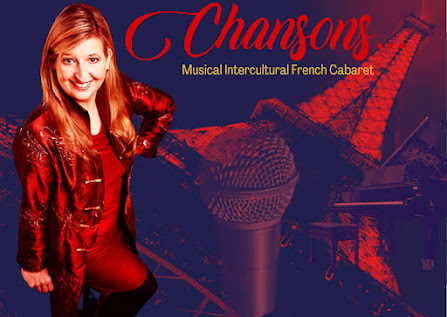
Fringe Festival - Chansons - Piaf, Brel and Me - Stefanie Rummel
The award-winning singer and actress, German born Stefanie Rummel presents “Chansons” her ‘musical theatre cabaret show’ about France.
‘Soul touching’ stories about life and songs from ‘Ne me quitte pas’ (Brel) to ‘Milord’ (Piaf) are performed in ‘Brilliant showmanship’ by Stefanie Rummel and her pianists.
Become part of the French way of living for one night without traveling and having jetlag. It does not matter if you speak French or not. This ‘Heart connecting performance’ can inspire our own lives by looking at other cultures. Online and offline shows are performed in theaters and cabarets in Germany, Iceland, New Zealand, Finland, France, Norway, Edinburgh, Lathi, US...
It felt a bit odd attending my first Fringe show in my pajamas. Usually, I’m all dressed up, glass in hand, chatting away to my newly met neighbor as the lights go down. Not tonight.
Instead, what I got was a ‘live’ zoom recording of her show, done as an interactive ‘workshop’. It reminded me of those ‘garage’ performances bands tried to do during lockdown in 2020. It sort of worked. But nobody’s fooling anyone – this is not actually theatre. It’s all online. So, get used to it. This is how we roll with covid. It’s like that online gambling advert on the telly, you call the shots. Watch when and where, how you like and with who you like. You can even get crumbs in the duvet, no one will know. Now on with the show.
Rummel opens with ‘Ne me quitte pas’ written by Jaques Brel. A soft, melancholic love song begging the listen to remain – “Let me be your shadow/ Don’t leave me…” Perhaps a request for her online audience to settle in. Accompanied only by piano, it’s a simple start but a taste of her usual performance. It’s something we see a lot of in Wellington Fringe shows, but usually in person.
There are interactions with her online audience and she tells stories of French culture. Like a visit to clients that starts off as a 10-minute visit and morphs into a multi hour 7 course meal. “After seven hours we left this place, and we are friends ever since! That’s what makes life so special.”
Another tale is about a Gendarme holding up traffic for a snail crossing the road – ‘l'escargot est roi’
‘Milord’ from the ‘Little Sparrow’ aka Edith Piaf comes from a recording done in a jazz bar in Reykjavík and you can hear the murmur of the audience, their whooping and clapping. I guess this adds a bit of live flavour.
She asks her online audience about their aspirations and plans for the future. They share. Two of the have plays and musicals that need to be staged once they get out of lockdown. Rummel notes that these are big things. Her next song is the opposite, ‘Je veux’ is about the little things. It’s hilarious, with a kazoo accompaniment, she sings ‘I need your love, joy, humour/ I prefer a hand on the heart…” This is a song I didn’t know but I really enjoined bon vivant of the performance.
She also shares a short video she’s made about ‘The Bridge of Avignon’;teaches her audience a song from the 18th Century, which we know as ‘Frère Jacques’. They join in, very badly, partially due to lagging. Partially due to bad singing. We then get another video, this time with puppets, which was a bit naff. Like an international Muppet delegation. Still, it made me giggle.
She tells stories about shopping and the French love of art, fashion and design. We get another video with the Muppets, this time about art. This is follows by another Piaf song about a woman who falls in love with a musician (‘L’Accordeoniste’).
She also does a the original of ‘My Way’. Apparently, David Bowie was the first person to write English lyrics to the original tune of what eventually became the global hit. But it was French man Claude Francois, a big name in his native France, who wrote and performed the original song called ‘Comme d'habitude’ ('As Usual).
Rummel is clearly fluent in French and sings like a native. She’s studied the nuances and subtleties of each chanson and this clearly comes through. A master class is French cabaret.
“What we can’t say. And what we can’t be quiet. The music is expressing.’ – Victor Hugo
Book to see this show - https://fringe.co.nz/show/chansons-songs-and-stories-from-piaf-brel-and-me